
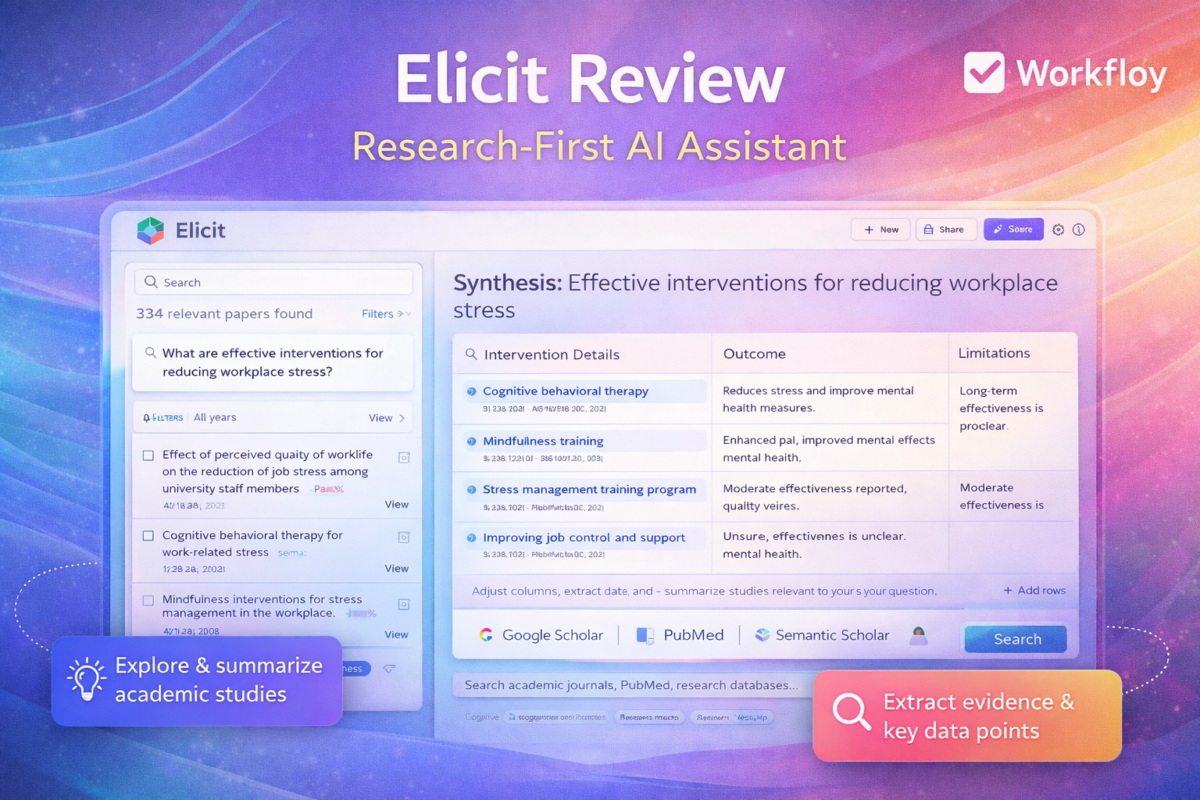
Elicit is an AI research assistant designed to help users find, summarize, and synthesize academic and evidence-based sources. Rather than generating content from scratch, Elicit focuses on turning research questions into structured insights that can be used for writing, analysis, and decision-making.
This review evaluates Elicit as an evergreen AI writing tool for research-first workflows—where evidence quality, traceability, and synthesis matter more than speed or marketing polish.
What Elicit Is
Elicit is best understood as a research-to-writing bridge.
- It does not aim to replace academic databases or general AI writers
- It does accelerate literature discovery, evidence extraction, and summary building
Users typically rely on Elicit before drafting, to ground writing in credible sources.
How Elicit Is Commonly Used
In real workflows, Elicit supports research-heavy tasks that benefit from structure and citations.
Elicit is most effective when used to structure and accelerate literature review, not to replace academic judgment.
In practice, researchers use Elicit to surface relevant papers, extract key claims, and compare findings across studies without manually scanning dozens of PDFs.
Its real value lies in reducing search and synthesis time during early-stage research, allowing users to focus more on interpretation and critical thinking.
Common use cases include:
- Exploring research questions and related papers
- Summarizing findings across multiple studies
- Extracting key variables, outcomes, and limitations
- Supporting academic, policy, or analytical writing
- Building evidence-based briefs and reports
Elicit is often paired with a general AI writer for drafting, after the research phase is complete.
Key Strengths in Practice
Research-First Design
Elicit prioritizes peer-reviewed literature and credible sources, making it well-suited for evidence-driven writing.
Structured Evidence Extraction
The tool helps surface study details—methods, sample sizes, and outcomes—without reading every paper in full.
Source Transparency
Unlike many generative tools, Elicit keeps sources visible, which supports verification and responsible use.
Time Savings for Literature Review
For early-stage research and scoping, Elicit significantly reduces manual search and screening time.
Where Elicit Falls Short
Not a General Writing Tool
Elicit does not generate polished prose or creative drafts. Its output is research input, not finished content.
Coverage Depends on Available Literature
If a topic lacks published studies, Elicit’s usefulness drops accordingly.
Learning Curve for Non-Researchers
Users unfamiliar with research methods may need time to interpret results effectively.
Who Elicit Is Best For
Elicit is a strong fit for:
- Researchers and students conducting literature reviews
- Analysts preparing evidence-based reports
- Writers who need credible sources before drafting
- Teams working on policy, science, or data-driven content
It is not ideal for marketing copy, creative writing, or rapid content production without citations.
Choose Elicit if your work involves reviewing, comparing, or synthesizing academic research at scale.
It is particularly well suited for students, researchers, and analysts who need structured insights from scholarly sources rather than conversational answers.
If your primary need is open-ended reasoning, writing, or general problem-solving, a general-purpose AI assistant may feel more flexible.
Elicit vs General AI Writing Tools
Elicit plays a different role than tools like ChatGPT, Gemini, or Writesonic.
- General AI writers focus on drafting and ideation
- Elicit focuses on research discovery and synthesis
Used together, they form a more reliable research-to-writing workflow.
How Elicit Fits in the AI Writing Tools Category
Within AI writing tools, Elicit occupies a specialized but important niche. It strengthens the quality of writing by improving the inputs—sources, evidence, and structure—before any text is written.
For users who care about accuracy and credibility, Elicit adds value where many generative tools fall short.
Editorial Verdict
Elicit is a focused AI research assistant that excels at evidence discovery and synthesis. While it is not a standalone writing solution, it plays a critical role in research-driven workflows and complements general AI writing tools effectively.