
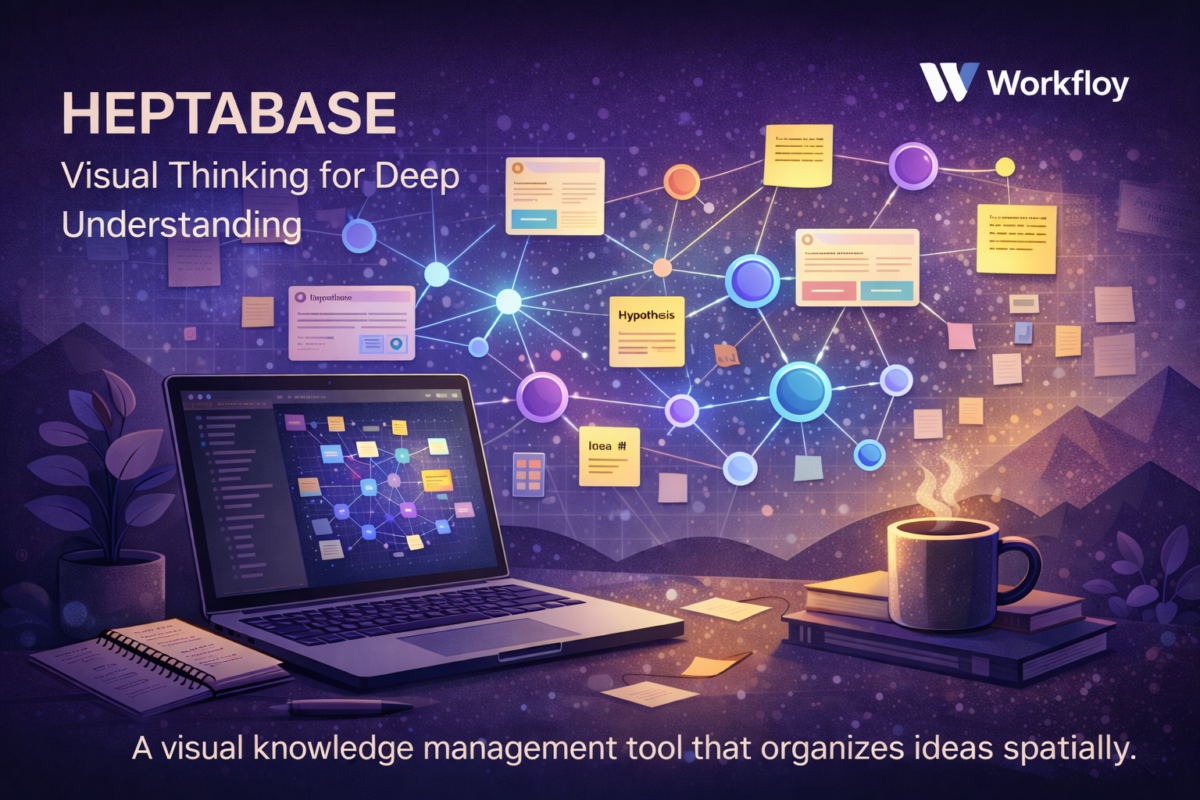
Heptabase takes a fundamentally different approach to knowledge work by prioritizing spatial reasoning over linear organization. Ideas are placed on visual canvases, allowing users to see relationships, patterns, and hierarchies at a glance rather than navigating folders or documents.
This design is intentionally focused on learning and sense-making. Heptabase is not optimized for quick note capture, task tracking, or daily planning; instead, it supports deeper understanding and conceptual clarity when working with complex or evolving subjects.
What Is Heptabase?
Heptabase is a visual-first knowledge management tool designed to help people understand complex topics by thinking spatially rather than linearly. Instead of organizing information as documents or lists, Heptabase uses visual canvases where ideas can be placed, grouped, and connected in space.
This approach mirrors how many people naturally reason about complex subjects—by seeing relationships, patterns, and hierarchies at once. Heptabase is not built for quick note capture or task tracking; it is built for learning, sense-making, and conceptual clarity.
How Visual Thinking Changes the Way We Learn
Text-based notes are effective for recording information, but they often fall short when ideas become dense or interdependent. Visual thinking addresses this gap by allowing concepts to be externalized in space, not just written down.
With spatial layouts, learners can:
- See how ideas relate at a glance
- Group concepts by meaning rather than chronology
- Reorganize understanding as knowledge evolves
Heptabase leverages this by turning notes into movable objects on a canvas, making learning an active process of arrangement and refinement rather than passive accumulation.
Core Use Cases of Heptabase
Heptabase excels in workflows where understanding matters more than storage.
Heptabase is most effective for visual sense-making—turning scattered inputs into structured understanding.
In practice, people use it to lay out papers, highlights, and notes on a visual canvas, then group and connect ideas until patterns become clear.
This workflow is especially helpful for research-heavy projects where linear note-taking feels too slow or too fragmented.
Learning & Concept Building
Heptabase is particularly effective for studying complex domains—such as science, technology, philosophy, or business—where concepts must be connected and revisited over time.
Research Synthesis
Researchers use Heptabase to visually organize sources, arguments, and interpretations. Instead of reading notes in isolation, ideas are synthesized on a canvas, revealing gaps and connections that are easy to miss in linear documents.
Strategy & Systems Thinking
For strategy work, Heptabase helps map systems, assumptions, and trade-offs. Visual layouts make it easier to reason about cause and effect, dependencies, and priorities.
Idea Exploration Before Writing
Many users rely on Heptabase as a pre-writing environment—clarifying structure and logic visually before turning ideas into prose.
Heptabase vs Text-Based Knowledge Tools
Text-based knowledge tools emphasize accumulation: capturing more notes, links, and references over time. Heptabase emphasizes exploration: understanding how ideas fit together right now.
Key conceptual differences:
- Visual canvases vs sequential text
- Seeing structure immediately vs building it gradually
- Spatial memory vs navigational memory
Heptabase is less about maintaining a massive archive and more about clarifying thinking in the moment.
Heptabase vs Obsidian: Visual vs Textual Thinking
Although both tools support deep thinking, they do so in different ways.
Obsidian supports networked textual thinking. It excels at building long-term knowledge through linked notes that grow over time.
Heptabase supports spatial conceptual thinking. It excels at helping users understand a topic by laying ideas out visually and iterating on their relationships.
Many advanced users combine the two:
- Heptabase for visual sense-making and learning
- Obsidian for long-term knowledge storage and reflection
They address different stages of the thinking process rather than competing directly.
Strengths and Limitations of Heptabase
Strengths
- Excellent support for visual and spatial learning
- Strong clarity when dealing with complex topics
- Encourages active thinking and reorganization
- Reduces cognitive overload compared to dense text notes
Limitations
- Less suitable for quick capture or daily notes
- Requires habit changes for text-centric users
- Not ideal for very large, archival knowledge bases
- Collaboration features are limited
Heptabase is most effective when used intentionally for learning and synthesis.
Who Heptabase Is Best For
Heptabase is particularly well suited for:
- Visual learners
- Researchers and students
- Strategic and systems thinkers
- Professionals learning complex, abstract subjects
It benefits users who value understanding and clarity over speed and volume.
When Heptabase Is (and Is Not) the Right Tool
Heptabase is a strong choice if you want to:
- Learn deeply rather than collect notes
- Understand relationships between ideas
- Think spatially about complex subjects
It may not be the right choice if you need:
- Fast task or note capture
- Linear documentation
- A general-purpose productivity tool
Choosing Heptabase is ultimately a decision about how you think, not just what features you want.
Choose Heptabase if your main problem is thinking through complexity, not capturing more notes.
It suits researchers, creators, and strategists who need a workspace for synthesis—linking concepts, building mental models, and refining direction over time.
If you primarily need fast capture, simple organization, or team collaboration, a lighter knowledge tool may fit better.